The Fancy Vivid Blue That Did Not Sell
The Cullinan Blue came to Sotheby's Geneva on the twelfth of May. 6.03 carats, Fancy Vivid Blue, internally flawless. It did not sell.
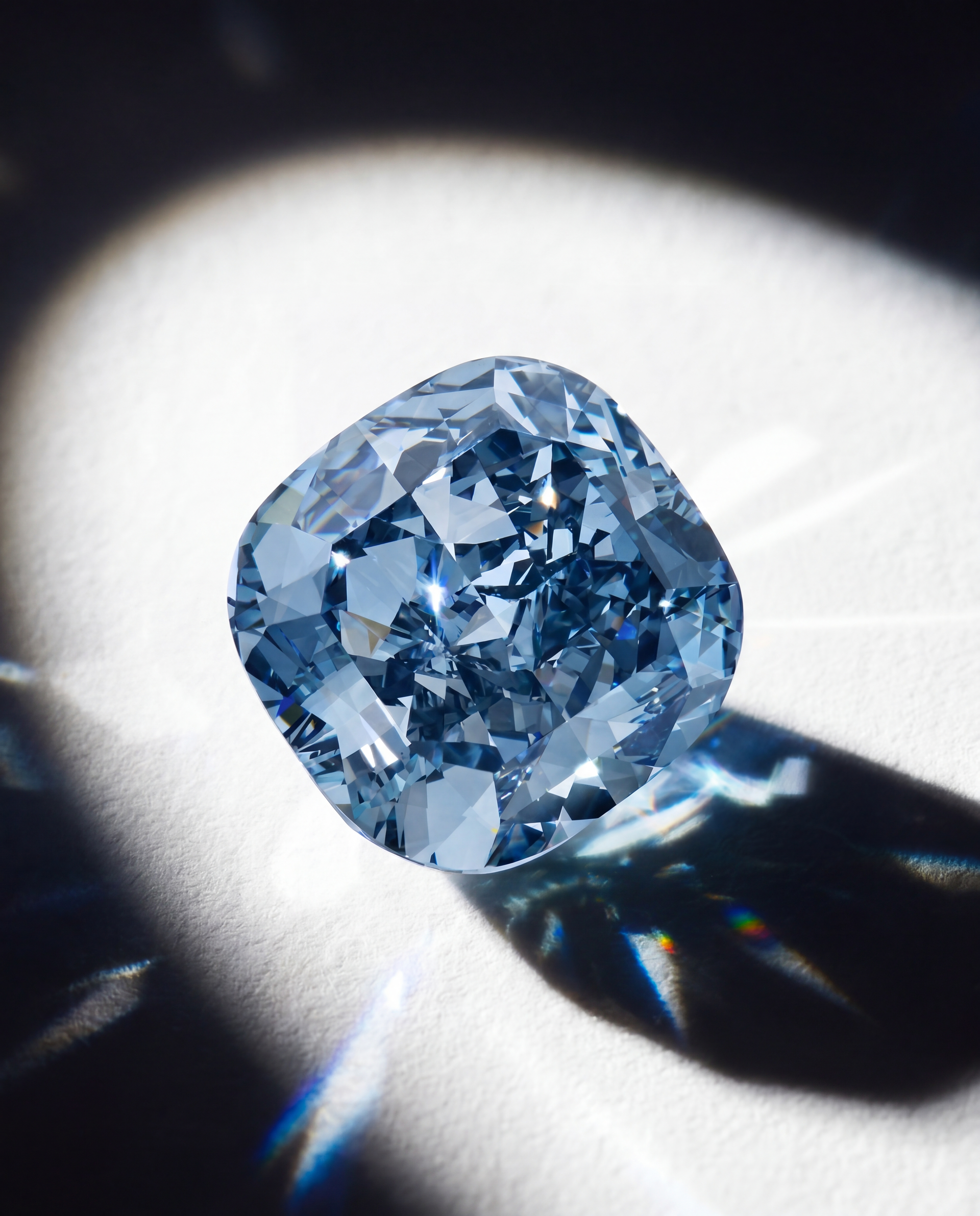
The Cullinan Blue came to Sotheby's Geneva on the twelfth of May. 6.03 carats, Fancy Vivid Blue, internally flawless. It did not sell. Nine days have now passed without the house releasing aggregate totals for the sale.
It is worth sitting with that sentence, because it is the most important sentence of the May auction season, and almost no one has written about it.
Auction houses do not stay silent for nine days after a major High Jewelry session. Press releases on aggregate totals usually go out within forty-eight hours. The pattern is so consistent that the absence itself is the news. The Cullinan Blue was the lot the catalog was built around. When the lot did not sell, the house had a decision: publish totals that would foreground the failure, or wait. They have, so far, chosen to wait.
This will be read as a story about the market for fancy vivid blue collapsing. It is not what happened. In the same Geneva week, the Ocean Dream — a 5.50-carat Fancy Vivid Blue-Green — sold at Christie's for $17.37 million. That is $3.16 million per carat. It is a world record for the color category. The Chaumet Kashmir sapphire, 22.28 carats, set a European benchmark at $157,600 per carat. Both lots had narrative. Both had names. Both had archival photographs from the houses they came from. The Cullinan did not. The catalog could only describe the stone itself.
The silence says something more specific, and more useful. The market for fancy vivid blue without authored provenance is finished — or at least dormant for a long enough cycle that no serious party wants to test it again soon. The market for fancy vivid blue with provenance set world records the same week.
This is a distinction that will define how blue diamonds are bought and sold for the next decade. A blue diamond without a name attached to it — without a house, without a previous owner of consequence, without an exhibition history — is now a discount asset, even at six carats and internally flawless. A blue diamond with a story is an entirely different instrument. The serious holders of such material have already begun re-papering their inventories — pulling old correspondence, old photographs, old shop tickets, and building narrative dossiers around stones that have not changed in chemistry but have, almost overnight, changed in what can be said about them.
If a blue diamond is in a collection somewhere, the work to do this year is not on the stone. It is on its file.